 Book a Call
The useful pricing question is not “What does every fractional CTO cost?” Published offers differ in responsibilities, availability, term and deliverables, and public price surveys rarely define those consistently. This guide separates Reyem Tech’s published offers from a buyer worksheet you can complete with your own hiring and contract assumptions.
Reyem Tech’s published offers#

| Offer | Published price | Published scope |
|---|---|---|
| CTO on Tap | $2,750/month for two sessions per month (biweekly) / $4,000/month for four sessions per month (weekly) | Advisory sessions; cadence is published, not an hourly allowance. |
| Fractional CTO | $8,000 / $12,000 / $16,000 per month | Retainer tiers of 5, 10 and 15 hours per week, with embedded technology leadership. |
| Interim CTO | from $15,000/month | Separate interim offer; confirm availability and responsibilities for your situation. |
These are Reyem Tech’s current published prices, not a Canadian market average or a promise that every engagement has the same total cost. Confirm the current scope, term, notice period, availability and any project expenses in a written proposal. Execution work is separately scoped; it is not included in these retainers by default.
The right comparison starts with the work you need done and the decisions you need covered. Do not compare a monthly retainer with a salary alone: compare the same period, responsibilities and expected availability.
Comparing engagement models#
An hourly advisory session, a defined assessment, an ongoing retainer and a full-time hire buy different things. Ask each provider to state the work, decision authority, expected access, response times, meeting cadence, exclusions, term and exit conditions. Ask how additional work is approved and priced. Do not infer a weekly hour commitment from a session cadence or a monthly fee.
For a contractor or consultancy, compare the written scope and total cost over the same period. A fixed-fee project should name its deliverables, assumptions, dependencies, acceptance criteria and change-control process. A retainer should explain what is included, how availability works, and whether unused capacity carries forward.
Reyem’s named offers above have their own published terms. A custom execution project is scoped separately after requirements and dependencies are understood; this guide does not publish generic project-price ranges.
What changes the quote?#
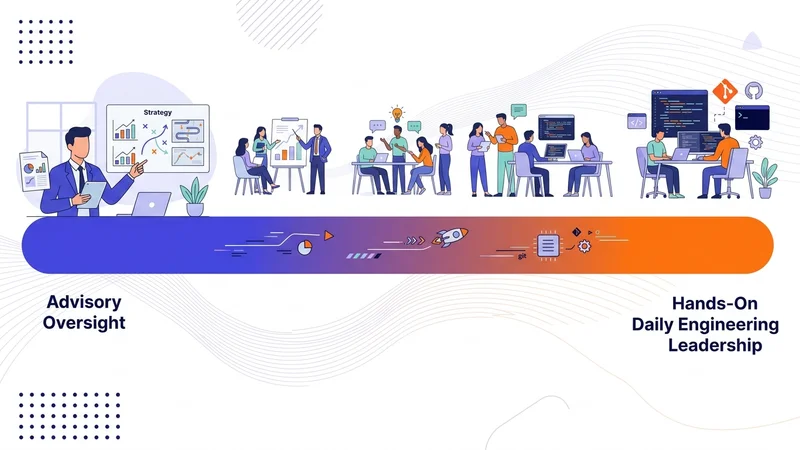
The quote should reflect the actual scope: decision ownership, team size and maturity, system complexity, delivery risk, required availability, urgency, travel or on-site expectations, and the length of the engagement. These factors help explain a specific proposal; they do not establish a universal price multiplier or prove that one city or industry always costs more.
Regulatory context also needs precision. PHIPA governs personal health information handled by Ontario health information custodians and their service providers. It does not categorically require that personal health information be hosted in Ontario or Canada. The custodian remains accountable for appropriate safeguards and should assess cross-border processing, contracts and applicable laws; see the Information and Privacy Commissioner of Ontario’s January 2026 guidance and the PHIPA statute.
OSFI Guideline B-13 sets technology and cyber-risk expectations for federally regulated financial institutions. It is not a general rule for every fintech or technology vendor. A vendor’s obligations depend on its relationship with a regulated institution, the institution’s risk assessment and contractual controls; see OSFI’s current B-13 overview.
ITAR is a United States export-control regulation. Canada’s Controlled Goods Program covers goods listed in the Canadian Defence Production Act schedule, including certain U.S.-origin defense articles controlled under the U.S. Munitions List. People and organizations that examine, possess or transfer controlled goods in Canada generally must register unless an exemption applies. See the Government of Canada’s pages on what counts as a controlled good and the Controlled Goods Program. Whether any of these requirements apply to a company or project requires a fact-specific review; a label alone does not determine the answer.
For any proposal, ask what relevant experience the provider can substantiate and what work is in scope. Do not treat a regulatory acronym as evidence of a mandatory premium.
Fractional CTO
from $8,000/month
Build your own full-time versus fractional comparison#
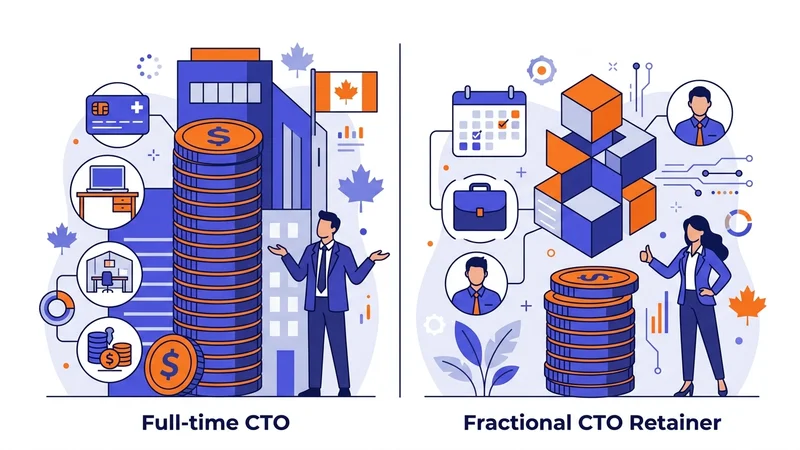
There is no universal salary, equity value, recruiting fee or “all-in” multiplier that fits every Canadian company. Build the comparison from your own written assumptions and compare the same time horizon, responsibilities and expected coverage.
| Cost or decision input | Full-time hire: enter your assumptions | Fractional engagement: enter your proposal |
|---|---|---|
| Base salary | $250,000–$400,000 per year (owner-provided range; not a market survey) | $8,000 / $12,000 / $16,000 per month for 5, 10 and 15 hours per week |
| Employer payroll costs and benefits | $________ per year | $________ in included benefits or expenses |
| Recruiting, search and interview time | $________ one-time | $________ one-time, if any |
| Onboarding, equipment and ramp-up | $________ one-time | $________ one-time and expected ramp-up |
| Equity | Your grant, vesting and dilution assumptions: ________ | Equity, if any: ________ |
| Coverage and decision authority | Hours, responsibilities and availability: ________ | Hours, responsibilities and availability: ________ |
| Exit, notice and transition costs | ________ | ________ |
| Comparable total over ______ months | $________ | $________ |
Use your finance team’s payroll estimates for CPP, EI and benefits; current recruiting quotes for search costs; and your own board-approved method to model equity. Equity is not cash compensation, and its value depends on the grant terms and future outcomes. Record expected hiring time and ramp-up as operational assumptions rather than treating them as guaranteed savings.
The comparison can guide a decision, but it does not show that one model is always three or four times cheaper. A fractional offer may cover fewer hours or different responsibilities, and a full-time executive may own work outside the engagement scope. Make those differences visible beside the totals.
When a full-time CTO may fit better#
A full-time CTO can make sense when the work requires sustained daily executive ownership, the team and product need that level of dedicated coverage, and the company can support the role. Rather than use a fixed employee-count, funding-stage or monthly-spend threshold, list the decisions, responsibilities and expected duration that need one accountable leader. Include succession and transition planning in either model.
How Ontario's DMAP Program Can Offset the Cost#
Ontario offers the Digital Maturity Assessment Program (DMAP) through the Ontario Centre of Innovation (OCI). This program is designed to help small and medium-sized businesses assess their digital readiness and create a technology roadmap.
Here is how DMAP works in the context of a fractional CTO engagement:
The assessment phase is a $30,000 project. It covers a comprehensive technology audit, digital maturity scoring, gap analysis, and a strategic roadmap with prioritized recommendations. OCI reimburses $15,000 toward that project cost, leaving $15,000 for the company to cover.
This is the exact work that makes up the first phase of most fractional CTO engagements. The difference is that half of it is funded by the province.
The implementation phase is where it gets more interesting. Once the DMAP assessment is complete, your company qualifies for the Technology Demonstration Program (TDP). TDP reimburses up to $100,000 (50% of eligible costs) on an implementation project costing up to $200,000. The $200,000 is the project-cost ceiling; $100,000 is the maximum reimbursement.
That means the roadmap your fractional CTO builds during the assessment phase becomes the blueprint for a government-funded implementation. The technology projects identified in the assessment, whether it is a new ERP system, a data integration platform, or an AI pilot, can be partially funded through TDP.
The math for Ontario companies:
| Phase | Total Cost | OCI Funding | Your Cost |
|---|---|---|---|
| DMAP Assessment | $30,000 | $15,000 reimbursed | $15,000 |
| TDP Implementation | Up to $200,000 | Up to $100,000 (50% match) | Up to $100,000 |
| Total | Up to $230,000 | Up to $115,000 | Up to $115,000 |
We have completed multiple DMAP assessments for Ontario companies. The assessment becomes the foundation for everything that follows, and structuring it correctly from the start maximizes your eligibility for the TDP implementation funding.
If you are an Ontario-based company considering fractional CTO services, starting with a DMAP-funded assessment is the most cost-effective entry point. You get the technology roadmap you need, half the cost is covered, and you unlock access to significant implementation funding.
Measure outcomes without assuming a return#
A technology leader can help surface risks, compare options and track agreed work. That does not make avoided costs, delivery speed, hiring outcomes, vendor savings or investor terms certain. Before an engagement, document the baseline, the outcome you want, the metric, the measurement period, the owner and the dependencies.
| Question | Record before work starts |
|---|---|
| What business outcome matters? | __________________________________________ |
| What is the current baseline and source? | __________________________________________ |
| What change would count as useful? | __________________________________________ |
| Who owns measurement and what period applies? | __________________________________________ |
| What other teams, spending or decisions affect it? | __________________________________________ |
At review, compare the observed result with the baseline and account for other changes during the period. Do not attribute every improvement to one engagement, or convert a hypothetical avoided rewrite into guaranteed savings. Use the evidence to decide whether to continue, change scope or stop.
Ready to Talk Pricing?#
Every engagement starts with a conversation. No pitch, no obligation. 30 minutes to understand your technology challenges, evaluate fit, and outline what an engagement might look like.
If you are an Ontario business, ask about DMAP and TDP funding during the call. We can walk you through the application process and structure the engagement to maximize your grant coverage.
Related: Fractional CTO Services | What Is a Fractional CTO?
Written by

Mario is the kind of tech leader startups dream about but rarely get. A Fractional CTO with full-time firepower, he blends 25+ years of executive experience with hands-on dev chops that span Laravel, Ruby On Rails, React, React Native, AWS, Azure, Kubernetes, and much more. Whether he’s optimizing cloud costs, crafting MVPs, or mentoring founders, Mario’s brain runs like a load-balanced cluster—efficient, scalable, and always online. He’s got boardroom polish, dev terminal grit, and a sixth sense for turning chaos into clean architecture. From debugging Docker deadlocks to demystifying CDAP for SMBs, he moves fast and builds things—strategically.
Frequently Asked Questions
How many hours per week does a fractional CTO work?
There is no single standard commitment across providers. Reyem Tech’s Fractional CTO tiers are 5, 10, or 15 hours per week. CTO on Tap is a separate advisory offer for two or four sessions per month; Interim CTO is scoped separately.
Can I start with advisory and move to hands-on later?
Yes. This is the most common progression. Many engagements start with a technology audit, then transition to a hands-on retainer once the roadmap is clear.
Do fractional CTOs work on-site or remotely?
Most engagements in Canada are hybrid. Strategic work happens remotely. Team leadership and critical decision meetings often benefit from in-person presence.
How long does a typical fractional CTO engagement last?
The median is 12-18 months. Some companies need 6 months during a specific transition. Others maintain the relationship for 2-3 years.
What is the difference between a fractional CTO and a technology consultant?
A consultant delivers a report and moves on. A fractional CTO embeds within your team, takes ownership, and stays accountable for outcomes. The difference is ownership.
Is a fractional CTO worth it for a company under $5M in revenue?
Yes, particularly if technology is central to your operations. The advisory tier, from $2,750/month, is designed for companies at this stage.