 Book a Call
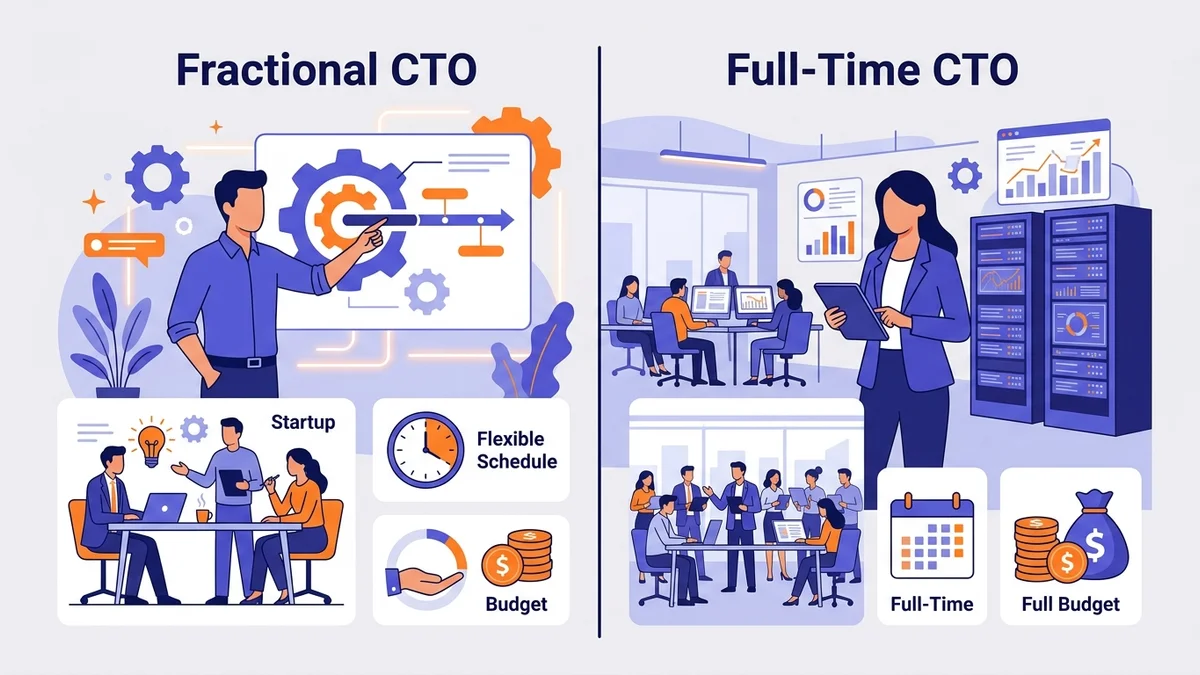
The question is not whether you need a CTO. If you are reading this, you probably do. The question is what kind of fractional CTO engagement (or, in some cases, full-time hire) your company actually needs right now, and whether the answer changes in 12 months.
Most articles on this topic frame it as a simple binary — fractional CTO vs full-time CTO — and ask you to pick a side. That framing is the most common, and it is also the most misleading. The real picture is a ladder. The Technology Health Check is the fixed-price entry point — a way to figure out where you actually stand before committing to a retainer of any size. The advisory rung sits above it. Embedded fractional leadership is the rung above that. Execution-ready engineering is the top of the ladder. Most companies don't need to choose between two CTO models — they need to pick the rung that matches the decisions on their plate today.
This guide walks through the comparison honestly, including the rungs the binary framing tends to skip. There are situations where a full-time CTO is the right call. There are situations where fractional is clearly the better path. And there is a path most companies overlook entirely — promoting an internal lead and pairing them with fractional oversight — that turns out to be the best fit more often than the standard advice suggests.
Where Health Check + CTO on Tap fit in the ladder
Pick the rung that matches where you are. Each step is a real, productized engagement.The Reyem Tech ladder
Reyem Tech runs every rung of this ladder. The $2,000 Technology Health Check is a 2-week, fixed-price engagement that gives you a written assessment of where your tech actually stands — a risk register, prioritised recommendations, and a 45-minute readout call. If you bring us on after, the full $2,000 credits against your third month on a retainer (month-to-month, no lock-in). It's the cheapest way to convert "something feels off" into a decision. CTO on Tap is the advisory rung — a $2,750-$4,000/month retainer for the recurring moments when a non-technical owner needs senior technology judgment on their side of the table (RFPs, security questionnaires, vendor-risk assessments, insurance attestations, build-vs-buy decisions). Fractional CTO is embedded leadership for teams that need a technology executive in the room on an ongoing basis. Execution-Ready is when we build and ship alongside you.
The "fractional vs. full-time" question collapses three of those rungs into one, then asks you to compare it to a fourth thing — the full-time CTO — that's a different shape entirely. Holding the ladder in mind while you read the rest of this article is the easiest way to spot which rung your company is actually on.
Side-by-Side Comparison
The "fractional vs. full-time" question is really three options, because "fractional" in 2026 splits into two distinct products: an advisory retainer (borrowed senior judgement, no execution scope) and a hands-on fractional CTO (embedded leadership with execution scope). Comparing all three against a full-time hire makes the actual choice visible:
| Factor | Full-Time CTO | CTO on Tap (advisory retainer) | Fractional CTO (hands-on) |
|---|---|---|---|
| Monthly cost (CAD) | $32,000 - $65,000 (total compensation) | $2,750 - $4,000 | $8,000 - $25,000 (retainer) |
| Availability | 40-50 hours/week, dedicated | 2-4 hours/week, advisory only | 10-20 hours/week, shared across clients |
| Engagement shape | Permanent employee | Senior advisor on retainer; you bring the questions, we bring the judgement | Embedded leadership with execution scope across your team and vendors |
| Time to productive | 3-6 months (recruit) + 2-3 months (onboard) | 1-2 weeks | 2-4 weeks |
| Commitment | Permanent employment | Month-to-month | Month-to-month or quarterly |
| Equity required | Typically 1-3% at Series A | None | None |
| Recruiting cost | $62,500 - $87,500 (25% of salary) | None | None |
| Severance risk | 3-12 months salary | 30-day notice | 60-day notice |
| Cross-industry experience | One company at a time | Multiple companies simultaneously | Multiple companies simultaneously |
| Accountability | Full organizational ownership | Defined advisory scope | Defined execution scope, shared ownership |
| Cultural integration | Deep, over time | Light, by design | Moderate, by design |
| Best fit | Tech is the product; 30+ engineers; post-Series B | Non-technical owner with external technical pressure; or a tech team that needs a senior second opinion without adding a leader | A real engineering team needs leadership now, but full-time isn't justified yet |
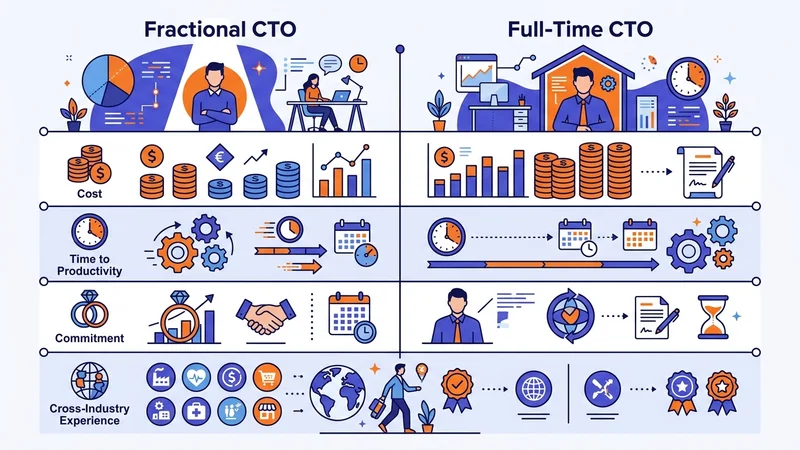
The cost line is the one most people focus on, but the lines that matter more are time to productive, commitment, and cross-industry experience. A fractional CTO who has seen your exact problem at three other companies will solve it faster than a full-time hire who is encountering it for the first time, regardless of how talented they are. And a CTO on Tap advisor who has answered the same insurer's security questionnaire at six other SMBs gets you a defensible answer in an afternoon, not a month.
When Full-Time Makes Sense
A full-time CTO is the right hire when three conditions are true simultaneously:
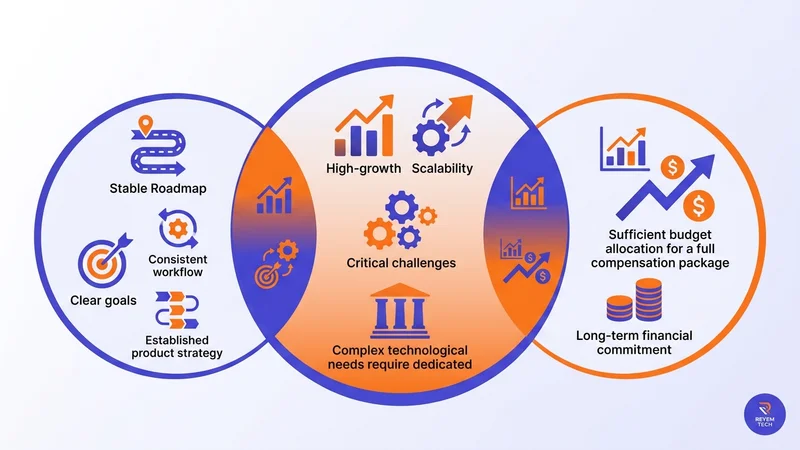
Technology is your core product. If you are a SaaS company, a platform business, or any company where the technology is what customers buy, you need someone whose entire professional identity is tied to your product. A fractional CTO can help you get to product-market fit, but once you are scaling a technology product, the CTO role demands full-time presence and full ownership.
You have 30+ engineers. Managing an engineering organization of this size is a full-time job. Sprint planning across multiple teams, technical hiring at volume, career path development, architecture governance, incident management. These responsibilities do not compress into 20 hours a week. If your engineering team is this large, you need someone who is in the building (or on Slack) every day.
You are post-Series B (or equivalent revenue). At this stage, the company has the revenue or funding to justify the total cost of a full-time CTO ($390,000 - $780,000+ annually in Canada when you include salary, benefits, payroll taxes, equity, and recruiting). The business is mature enough to offer a CTO a meaningful role with real scope, and the technical challenges are complex enough to require dedicated leadership.
If all three are true, hire a full-time CTO. If only one or two are true, fractional — or one of the lighter rungs of the ladder above — is likely the better path for now.
When Fractional Makes Sense
Fractional CTO leadership fits a specific profile. The company is growing, technology matters, but the need does not justify a permanent executive hire.

You are a non-tech company. Your business is built on a service, a product, or an operational model that happens to rely on technology. You are not a software company. You need someone who can set the technology strategy, manage vendors, oversee your developers, and present to the board. You do not need someone sitting in your office 40 hours a week. (If you don't have developers in-house yet and the need is mostly external — answering security questionnaires, sitting in on vendor calls, reviewing contracts — the CTO on Tap advisory retainer is often the right rung; fractional is for when there's a team to lead.)
You are in transition. Your CTO just left. You are going through a platform migration. You acquired a company and need to integrate the technology stacks. You are preparing for a funding round and need credible technical leadership for due diligence. These are high-stakes situations with a defined time horizon. A fractional CTO brings experienced leadership without the 6-month delay of a permanent hire.
You need strategy more than headcount. Your development team can build things. What they lack is direction. Which tools to use. How to architect for scale. What to build next and why. Whether to buy or build. A fractional CTO brings the strategic layer that turns a group of developers into a technology function with clear direction.
You are pre-revenue or early stage. Startups that have not yet found product-market fit rarely need a full-time CTO. They need someone who can make smart architecture decisions, set up the development process, and help the founder hire the first 2-3 engineers. A fractional CTO at 10-20 hours a week covers this without burning $350,000 a year on a full-time hire before the company has revenue.
The Third Option: Promote Your Dev Lead + Add Fractional Oversight
This is the option most companies overlook, and it is often the best one.
You have a senior developer or engineering lead who knows your codebase, your team, and your business. They are technically strong but they have never been a CTO. They do not know how to build a technology roadmap, present to a board, evaluate an acquisition target's tech stack, or architect a system for 10x the current scale.
Instead of replacing them with an expensive external hire, promote them to a technical leadership role and pair them with a fractional CTO who provides the strategic oversight they lack.
How this works in practice:
- The fractional CTO meets weekly with your tech lead (1-2 hours)
- Together they define the technology roadmap and architecture standards
- The tech lead runs day-to-day execution with the team
- The fractional CTO handles board presentations, vendor negotiations, and strategic decisions
- The tech lead grows into the CTO role over 12-18 months with mentorship
This sits at the lower end of the Fractional CTO range — $8,000 to $10,000 per month — because the internal tech lead carries day-to-day execution; the fractional CTO is in for oversight, board prep, vendor negotiations, and mentorship rather than full embedded leadership. It preserves the institutional knowledge your tech lead carries and develops internal leadership instead of bypassing it. It is the most cost-effective path for companies where the existing technical talent is strong but strategically inexperienced.
We have run this model with multiple companies. In most cases, the tech lead becomes a capable CTO within 12-18 months and the fractional engagement ends naturally. The company gets a CTO who knows the business deeply, and they developed that talent at a fraction of what an external hire would have cost.
Canadian Cost Comparison in Detail
The full-time CTO cost in Canada is higher than most business owners expect when you add up all the components:
| Cost Component | Full-Time CTO (CAD/year) | Notes |
|---|---|---|
| Base salary | $250,000 - $350,000 | Toronto/Vancouver top of range |
| CPP contributions (employer) | $4,000 - $4,500 | 2026 rates |
| EI premiums (employer) | $1,400 - $1,500 | 2026 rates |
| Health and dental benefits | $8,000 - $15,000 | Group plan contribution |
| Life/disability insurance | $3,000 - $6,000 | Standard executive coverage |
| Vacation (4-5 weeks) | Included in salary | But reduces available hours |
| Equity (1-3%) | $50,000 - $300,000+ | Opportunity cost to founders |
| Recruiting fees | $62,500 - $87,500 | One-time, 25% of first-year salary |
| Onboarding cost | $15,000 - $30,000 | Equipment, training, lost productivity |
| Year 1 total | $394,000 - $794,000+ | Including one-time costs |
| Ongoing annual | $316,000 - $676,000+ | Excluding one-time costs |
Annual cost compared across the three options
| Engagement | Year 1 (CAD) | Ongoing annual (CAD) | What you get |
|---|---|---|---|
| CTO on Tap (advisory retainer) | $33,000 - $48,000 | $33,000 - $48,000 | 2-4 hours/week of senior advisory; no equity, no recruiting, no onboarding |
| Fractional CTO (hands-on) | $96,000 - $300,000 | $96,000 - $300,000 | 10-20 hours/week of embedded leadership; no equity, no recruiting, no onboarding; productive in 2-4 weeks |
| Full-Time CTO | $394,000 - $794,000+ | $316,000 - $676,000+ | 40-50 hours/week dedicated; includes equity, benefits, recruiting fees, and onboarding cost |
A few takeaways the table makes obvious:
- CTO on Tap is cheaper than a single senior developer's annual salary. For a non-technical owner who needs senior judgement a few hours a week, the math is rarely a close call.
- A hands-on fractional CTO at the midpoint (around $15,000/month = $180,000/year) costs less than the ongoing cost of a full-time CTO at the bottom of the range — without any of the equity, recruiting, or onboarding overhead. And the fractional CTO is productive in 2-4 weeks, not 6-9 months.
- The gap widens further when you factor in the risk of a bad hire. If the full-time CTO does not work out within the first year, you are looking at $400,000+ in sunk costs (salary paid, recruiting fees lost, severance, re-recruiting) and 12-18 months of lost progress. A retainer engagement that does not work out costs you one month of retainer and the agreed notice period (30-60 days depending on the rung).
Picking the Rung That Matches You
If the options described above feel like they blur together, here is the shortest path to the right one for your situation right now:
- The questions you get are mostly external (RFPs, security questionnaires, vendor calls, insurer attestations, contract reviews) and you don't have engineers in-house — start with CTO on Tap. You don't need execution muscle; you need senior judgement when the questions land.
- You have a development team but the constraint is direction, not delivery — a hands-on Fractional CTO puts an executive in the room week over week. They own architecture, vendor decisions, hiring, and roadmap; the team owns the build.
- The team can already build, and a specific thing needs to ship (a new product, a migration, a remediation flagged by the Health Check) — Execution-Ready picks up the work when the constraint is engineering capacity, not judgement.
- You aren't sure where you stand — start with the $2,000 Technology Health Check. Two weeks, a written report, and a clear view of which rung fits your situation. If you bring us on, the full $2,000 credits against your third month on a retainer (month-to-month, no lock-in).
The answer can change as you grow. Most companies start at one rung and graduate up (or sideways) as the work shifts. The framework below walks through the decision in more detail.
Decision Framework
Answer these questions to determine which model fits your company right now:
Hire full-time if:
- Technology is your core product (customers buy the software)
- You have 30+ engineers across multiple teams
- You have Series B+ funding or $20M+ in revenue
- You need someone dedicated 50 hours/week indefinitely
- All four of these are true simultaneously
Go hands-on Fractional CTO if:
- Technology supports your business but is not the product
- You have fewer than 30 engineers and a development team that needs senior leadership in the room week over week
- You are pre-Series B or under $50M in revenue
- You need strategic leadership AND ongoing accountability for outcomes, not just advice
- You are in a transition (CTO departure, migration, fundraise, acquisition)
- Any one of these is true
Promote + fractional oversight if:
- You have a strong technical lead who lacks strategic experience
- You want to develop internal leadership
- Your budget is $8,000 - $10,000/month for the fractional layer (low end of the hands-on Fractional CTO range, because the internal tech lead carries execution)
- You value institutional knowledge and continuity
Start with CTO on Tap (advisory) if:
- You are a non-technical owner with no in-house engineering
- The decisions you need senior judgment on are recurring but not full-time (RFPs, security questionnaires, vendor calls, insurance attestations, contract reviews)
- You want borrowed technical authority on a retainer rather than a fixed monthly cost of leadership you don't fully use
Start with a Technology Health Check if:
- You aren't sure yet which rung fits, and you want a written, fixed-price assessment of where your tech actually stands before committing to a retainer of any size
The answer can also change over time. Many companies start with a Health Check, graduate into CTO on Tap, then move up to Fractional CTO as the engagement deepens, and eventually hire full-time when the scale demands it. The fractional CTO who helped you get there is often the best person to define the full-time role and run the search.
Ready to Decide?
If you are weighing these options for your company, the fastest first step is the Technology Health Check — $2,000, fixed scope, ~2 weeks, a written report and a 45-minute readout call. You will come out with a clear view of where you stand and which rung of the ladder fits your situation. If you bring us on after, the full $2,000 credits against your third month on a retainer — month-to-month, no lock-in.
If you'd rather talk first, a 30-minute conversation will give you orientation. We will talk through your specific situation, team size, technology challenges, and growth plans, and give you an honest read on which rung fits.
Book your Technology Health Check → · Book a free strategy call →
Related: Fractional CTO Cost in Canada 2026 | 7 Signs You Need a Fractional CTO | CTO on Tap — advisory retainer | Technology Health Check | Fractional CTO Services
Written by

Frequently Asked Questions
CTO on Tap is advisory only. You bring the questions; we bring the judgement. There is no execution scope — the advisor doesn't run sprints, manage your team, or own delivery. It's a $2,750-$4,000/month retainer for 2-4 hours a week of senior judgement on recurring decisions (RFPs, security questionnaires, vendor calls, contract reviews).
A hands-on Fractional CTO owns outcomes. Same senior judgement plus actual leadership of your engineering function — running planning, reviewing architecture, interviewing senior hires, owning the roadmap. It's $8,000-$25,000/month for 10-20 hours a week of embedded leadership. The right rung depends on whether your constraint is advice or leadership accountability.
2-4 weeks for a hands-on Fractional CTO; 1-2 weeks for CTO on Tap. Compare that to a full-time hire: 3-6 months to recruit, plus another 2-3 months for an external hire to learn the business well enough to lead it. The shorter time-to-productive is the second-biggest reason companies choose fractional, after cost — and in transitions (departing CTO, due diligence deadline, stalled migration), it's often the primary reason.
60-day notice for a hands-on Fractional CTO; 30-day notice for CTO on Tap. No severance, no equity clawback, no recruiting costs to write off. Compare that to a full-time miss: 3-12 months of severance, lost recruiting fees, 12-18 months of lost progress, and the company-internal damage of a public leadership change. The risk asymmetry is one of the strongest arguments for trying a retainer before committing to a full-time hire.
Yes — and it's the most common path. Many of our engagements end naturally when the company has grown to the point where full-time leadership is justified. The fractional CTO who built the roadmap is often the best person to define the full-time job description, screen candidates, and run the handoff. The Health Check → CTO on Tap → Fractional CTO → Full-Time path is the standard ladder; very few companies skip rungs.
No. Most non-technical owners don't, and the Technology Health Check exists for exactly that situation: a $2,000, two-week, written assessment of where your tech actually stands — stack, architecture, team, risk — delivered in plain language. You don't need to translate any of it. The walkthrough call exists to make sure you can act on the recommendations.
By partnering with us, you can expect improved efficiency, increased competitiveness, enhanced customer experiences, and the ability to adapt and thrive in a rapidly evolving digital landscape. Our goal is your success.
Yes, we tailor our services to meet the unique needs of various industries, ensuring that solutions are aligned with specific regulatory and operational requirements.
We have done projects in the most diverse industries possible, including but not limited to Services, Finance, Manufacturing, Health, Education, Food & Beverage and Technology.
Yes, our solutions are highly customizable to meet your specific requirements and needs. We work closely with our clients to deliver tailored solutions.
To begin your journey with Reyem Technologies, simply reach out to us through our email or book a call with us. We'll be happy to discuss your needs and explore how our services can benefit your organization's goals.
You can contact us through the contact form on our website or by sending an email to contact@reyem.tech .