 Book a Call

If you're running a growing company and the words "we need someone to own the technology" keep coming up in leadership meetings, you've probably stumbled across the term fractional CTO. Maybe your co-founder mentioned it. Maybe an investor suggested it. Maybe you just Googled it at midnight after your third deployment failure this quarter.
Whatever brought you here, this guide will give you a clear, practitioner-level understanding of what a fractional CTO is, what they actually do, who hires them, and how to find the right one — especially if you're operating in Canada.
I'm Mario Meyer. I've spent 25+ years in technology leadership, and I run Reyem Tech, a fractional CTO consultancy based in Toronto. I've seen this model from every angle — as a full-time CTO, as an advisor, and now as someone who does this work every day across multiple companies. This isn't theory. This is how it actually works.
What Is a Fractional CTO, Exactly?
A fractional CTO is an experienced technology executive who serves as your company's Chief Technology Officer on a part-time, contracted basis. They bring the same strategic leadership, technical decision-making, and team oversight as a full-time CTO — but they work with your company for a fraction of the hours, and typically a fraction of the cost.
The "fractional" part refers to time allocation, not capability. A good fractional CTO isn't giving you a diluted version of the role. They're giving you concentrated, high-leverage leadership for the hours that actually matter.
Think of it this way: most companies under 50 employees don't need a CTO sitting in meetings 40 hours a week. They need someone who can make the right architectural call on Tuesday, unblock the dev team on Wednesday, present the technology roadmap to the board on Thursday, and then go do the same for another company on Friday.
This model has grown rapidly over the past five years, particularly in Canada's startup and SMB ecosystem. The shift to remote and hybrid work made geography irrelevant for executive leadership. Companies realized they could access senior tech talent without the $250K-$400K+ commitment of a full-time executive hire.

What a Fractional CTO Is Not
Before we go further, let's clear up what this role is not:
- Not a freelance developer. A fractional CTO isn't writing your code day-to-day (though some will roll up their sleeves when needed). They're setting direction, making architecture decisions, and leading your technical people.
- Not a consultant who drops a PDF and disappears. The whole point of "fractional" is ongoing engagement. They're embedded in your operations, attending standups, reviewing pull requests, sitting in on hiring calls.
- Not a temporary placeholder. While some engagements are transitional, many companies work with a fractional CTO for years. It's a sustainable model, not a stopgap.
Fractional CTO vs Part-Time CTO vs Interim CTO vs Virtual CTO vs CTO as a Service
One of the most confusing things about this space is the alphabet soup of titles. Let me untangle them.
| Model | Relationship | Duration | Typical Commitment | Best For |
|---|---|---|---|---|
| Fractional CTO | Contracted executive, often across multiple clients | Ongoing (months to years) | 8-20 hrs/week | Companies that need sustained strategic tech leadership without a full-time hire |
| Part-Time CTO | Usually a single employer, reduced hours | Ongoing | 15-30 hrs/week | Companies that want a dedicated CTO but can't justify or afford full-time |
| Interim CTO | Temporary full-time replacement | Fixed term (3-9 months) | 40 hrs/week | Filling a gap after a CTO departure, during M&A, or leadership transition |
| Virtual CTO | Remote-first, advisory-leaning | Ongoing | 5-15 hrs/week | Smaller companies or early-stage startups needing remote technical guidance |
| CTO as a Service | Productized offering from a consultancy | Varies | Varies by tier | Companies that want a packaged, predictable service with defined deliverables |
Here's the honest truth: these terms overlap significantly, and people in the industry use them inconsistently. "Virtual CTO" and "fractional CTO" are often the same thing. "CTO as a Service" is usually just a fractional CTO engagement wrapped in a subscription model.
The meaningful distinctions come down to three things:
- Depth of involvement. Is this person attending your team meetings and doing code reviews, or just showing up for a monthly strategy call?
- Duration. Are they filling a temporary gap, or building a long-term relationship with your company?
- Number of clients. A fractional CTO typically serves 2-5 companies simultaneously. An interim CTO is usually dedicated to one.
When I work with companies through Reyem Tech, the engagement usually starts closer to the "virtual CTO" end — strategic calls, architecture reviews, vendor evaluations — and deepens into full fractional CTO work as we build trust and I learn the business.
What Does a Fractional CTO Actually Do Day-to-Day?
This is the question I get most often, and the answer is: it depends on you. But here's what a typical week looks like across my engagements:
Technology Strategy and Roadmapping
This is the core of the role. A fractional CTO translates business goals into a technology plan. What should you build? What should you buy? What should you defer? How does your tech roadmap support your next fundraise, your next product launch, or your three-year growth plan?
This isn't about picking the trendiest framework. It's about making technology decisions that align with your business reality — your budget, your team's skills, your market timeline.
Team Leadership and Development
If you have developers, a fractional CTO leads them. That means setting engineering standards, running (or restructuring) your development process, conducting architecture reviews, and mentoring your senior developers into future leaders.
For companies without a dev team, the fractional CTO helps you figure out when and how to build one — or whether you should outsource instead.
Technical Due Diligence
Investors, acquirers, and partners will want to know your technology is sound. A fractional CTO can prepare for and represent you during technical due diligence, covering code quality, infrastructure resilience, security posture, and scalability planning.
Vendor and Tool Evaluation
Should you use AWS or GCP? Shopify or a custom build? Salesforce or HubSpot? A fractional CTO brings experience across dozens of technology stacks and vendor relationships. They'll save you from expensive mistakes and negotiation traps.
Security and Compliance Oversight
From SOC 2 readiness to privacy regulation compliance (including Canada's PIPEDA and the evolving Bill C-27), a fractional CTO ensures your technical practices meet the standards your market demands.
Hiring and Talent Strategy
Building a technical team is one of the hardest things a growing company does. A fractional CTO defines roles, writes job descriptions, screens candidates, conducts technical interviews, and designs onboarding processes.
Who Hires a Fractional CTO?
Startup Founders (Pre-Seed to Series A)
You have a product idea, maybe an MVP, possibly some early revenue. You need technical leadership but you're not ready — or able — to pay a full-time CTO salary plus equity. A fractional CTO helps you make smart early decisions that you won't have to undo later. Wrong choices in architecture, hosting, or team structure at this stage are brutally expensive to fix at Series B.
Scaling SMBs ($1M-$20M Revenue)
Your product works. Customers are coming in. But the technology that got you here won't get you there. You're hitting scaling problems, your development team needs senior leadership, and you're drowning in technical debt. This is the sweet spot for a fractional CTO — enough complexity to need executive-level guidance, but not enough to justify a $300K hire.
Companies in Transition
You just lost your CTO. You're going through an acquisition. You're pivoting your product. You're migrating to the cloud. These are inflection points where having an experienced technology leader — even part-time — can be the difference between a smooth transition and a costly disaster.
Non-Technical Founders
If nobody on your leadership team has a deep technical background, a fractional CTO becomes your translation layer between the business and the technology. They protect you from being oversold by vendors, under-delivered by contractors, and blindsided by technical risks you didn't know existed.
If any of those scenarios feel familiar, you might want to read 7 Signs Your Business Needs a Fractional CTO for a deeper self-assessment.
Engagement Models: How Fractional CTO Arrangements Work
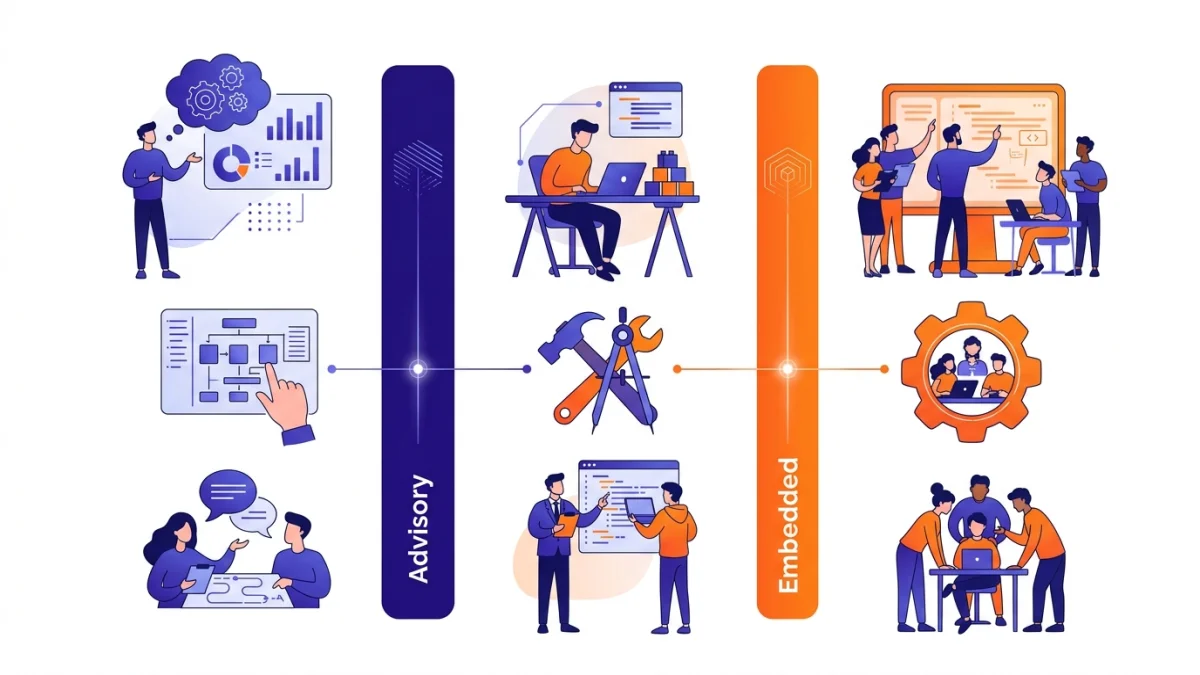
Fractional CTO engagements generally fall into three categories:
Advisory
The lightest model. Typically 4-8 hours per month. The CTO joins key meetings, reviews major technical decisions, and provides strategic guidance. Think of it as having a seasoned tech executive on speed dial.
Best for: early-stage companies with a capable dev lead who just needs a sounding board.
Hands-On
The most common model. Usually 10-20 hours per week. The CTO is actively involved in day-to-day technical leadership — attending standups, reviewing code, managing the dev team, and driving execution on the roadmap.
Best for: companies with a development team that needs direct leadership.
Embedded
The deepest engagement, approaching part-time CTO territory. 20-30 hours per week, often during critical periods like product launches, fundraising, or major migrations. The CTO functions as a near-full-time member of your leadership team.
Best for: companies going through transitions, rapid scaling, or preparing for a specific milestone.
For a detailed breakdown of what each model costs in the Canadian market, see Fractional CTO Cost in Canada 2026: The Complete Pricing Guide.
How to Evaluate and Hire the Right Fractional CTO
What to Look For
Breadth of experience, not just depth. A good fractional CTO has seen multiple industries, tech stacks, company stages, and failure modes. That pattern recognition is their superpower.
Communication skills. Technical brilliance is worthless if they can't explain trade-offs to a non-technical founder or board. Look for someone who can translate between business and engineering without condescending in either direction.
A track record of building, not just advising. The best fractional CTOs have actually built and shipped products, led teams through crises, and made hard calls with real consequences. Ask for specific stories, not just a list of past clients.
Cultural fit. This person will be part of your leadership team. They need to mesh with how you make decisions, handle conflict, and communicate.
Red Flags
- They promise to "fix everything" in 30 days. Real technology transformation takes time.
- They only talk about technology. A CTO who doesn't ask about your business model isn't thinking strategically.
- They push a specific tech stack before understanding your situation. Run.
- No references or case studies. Experienced fractional CTOs have a portfolio of results.
- They disappear between meetings. You're getting a consultant, not a CTO.
The Interview Process
- Discovery call. Do they ask smart questions about your business?
- Technical assessment. Have them review your current architecture.
- Strategy exercise. Give them a real business problem.
- Reference checks. Talk to previous clients at a similar stage.
- Trial engagement. Many fractional CTOs offer a short paid trial. Use it.
The Canadian Market Context
The Talent Pool Is Growing
Canada's tech ecosystem has matured significantly. Toronto, Vancouver, Montreal, and increasingly cities like Calgary, Ottawa, and Waterloo have deep pools of senior technology talent. Many experienced CTOs are choosing the fractional model deliberately.
You can explore what fractional CTO services look like in specific markets — for example, fractional CTO services in Toronto.

Government Programs That Work With This Model
- SR&ED: Tax credits for eligible R&D work. A fractional CTO can help you identify qualifying activities.
- IRAP: NRC's program provides advisory services and funding for innovation.
- BDC: Advisory services and financing specifically for tech companies.
- DMAP: Provincial digital transformation programs can fund technology consulting.
The Cost Advantage
Canadian fractional CTO rates are generally 20-40% lower than equivalent US rates. For specific numbers, see the pricing guide.
Common Misconceptions About Fractional CTOs
"It's just for startups." Wrong. Some of the most impactful engagements are with established SMBs doing $5M-$20M in revenue.
"You get less because they're part-time." The opposite is usually true. Cross-pollinated experience from multiple companies means compressed wisdom.
"They won't care about my company as much." Reputation is everything in the fractional world. The incentive alignment is actually stronger than a salaried executive.
"My company is too small." If you have technology-dependent operations and no senior tech leader, you're not too small.
"We should just hire a full-time CTO." Maybe. Read the fractional vs. full-time CTO comparison to decide.
"AI will replace this role." AI is making the strategic layer more important, not less.
Making the Most of a Fractional CTO Engagement
Be transparent about your business. Share financials, strategy documents, board decks — everything.
Give them access to your team. Don't bottleneck all communication through yourself.
Set clear priorities. "Fix everything" is not a brief. "Reduce deployment failures by 80%" is.
Commit to a reasonable timeline. Real impact typically shows up in months two and three.
Treat them as a partner, not a vendor.
Frequently Asked Questions
How many hours per week does a fractional CTO typically work?
Most engagements range from 8 to 20 hours per week. Advisory arrangements can be as light as 4-8 hours per month, while embedded engagements may reach 20-30 hours per week. The right number depends on your company's stage, complexity, and team maturity.
Can a fractional CTO manage a development team?
Yes, and many do. They can run standups, conduct code reviews, set engineering standards, and manage sprint planning. The key is setting clear expectations about availability and having a capable tech lead for day-to-day questions.
Is a fractional CTO the same as a technical consultant?
No. A consultant delivers a defined project and moves on. A fractional CTO has an ongoing relationship, builds context over time, and takes ownership of your technology strategy. They're accountable for outcomes, not just advice.
How do I know when to upgrade from a fractional CTO to a full-time CTO?
Common signals: your tech team has grown beyond 15-20 people, product complexity demands full-time attention, and you can afford the all-in cost. Many companies use their fractional CTO to help hire their full-time replacement. See Fractional CTO vs Full-Time CTO for the full framework.
What does a fractional CTO cost in Canada?
Canadian engagements typically range from $3,000 to $15,000+ per month. For a full breakdown, read the Fractional CTO Cost in Canada 2026 pricing guide.
If you're considering whether a fractional CTO is the right move for your company, the best next step is a conversation. I offer a free discovery call where we'll discuss your current technology situation, your business goals, and whether the fractional model makes sense for where you are.
Book a call with Mario and let's figure it out together.
Related: Fractional CTO Services | Book a Free Strategy Call
Written by

Frequently Asked Questions
Most fractional CTO engagements range from 8 to 20 hours per week. Advisory arrangements can be as light as 4-8 hours per month, while embedded engagements during critical periods may reach 20-30 hours per week. The right number depends on your company's stage, the complexity of your technology challenges, and the maturity of your existing team.
Yes, and many do. A fractional CTO can run standups, conduct code reviews, set engineering standards, manage sprint planning, and mentor developers. The key is setting clear expectations about availability and having a capable developer or tech lead who handles day-to-day questions in between.
No, though there's overlap. A technical consultant typically delivers a defined project — an architecture review, a security audit, a technology assessment — and then moves on. A fractional CTO has an ongoing relationship with your company, builds context over time, and takes ownership of your technology strategy. They're not just advising; they're accountable for outcomes.
The common signals are: your technology team has grown beyond 15-20 people, your product complexity demands full-time executive attention, and you can afford the all-in cost (salary, equity, benefits) without straining your budget. Many companies use their fractional CTO to help hire and onboard their full-time replacement.
Canadian fractional CTO engagements typically range from $3,000 to $15,000+ per month, depending on the engagement model and depth of involvement. Advisory arrangements start around $3,000-$7,000/month, hands-on engagements run $8,000-$15,000/month, and embedded (acting CTO) engagements can reach $15,000-$25,000/month.
By partnering with us, you can expect improved efficiency, increased competitiveness, enhanced customer experiences, and the ability to adapt and thrive in a rapidly evolving digital landscape. Our goal is your success.
Yes, we tailor our services to meet the unique needs of various industries, ensuring that solutions are aligned with specific regulatory and operational requirements.
We have done projects in the most diverse industries possible, including but not limited to Services, Finance, Manufacturing, Health, Education, Food & Beverage and Technology.
Yes, our solutions are highly customizable to meet your specific requirements and needs. We work closely with our clients to deliver tailored solutions.
To begin your journey with Reyem Technologies, simply reach out to us through our email or book a call with us. We'll be happy to discuss your needs and explore how our services can benefit your organization's goals.
You can contact us through the contact form on our website or by sending an email to contact@reyem.tech .