 Book a Call
Introduction to Dynamic Programming#
Dynamic programming is a powerful problem-solving strategy that has been transforming industries since its inception by Richard Bellman in the 1950s. It involves breaking down complex problems into smaller, more manageable sub-problems, solving each sub-problem only once, and storing their solutions to avoid redundant computation. This approach is particularly effective in optimizing recursive algorithms, reducing their time complexity from exponential to polynomial.
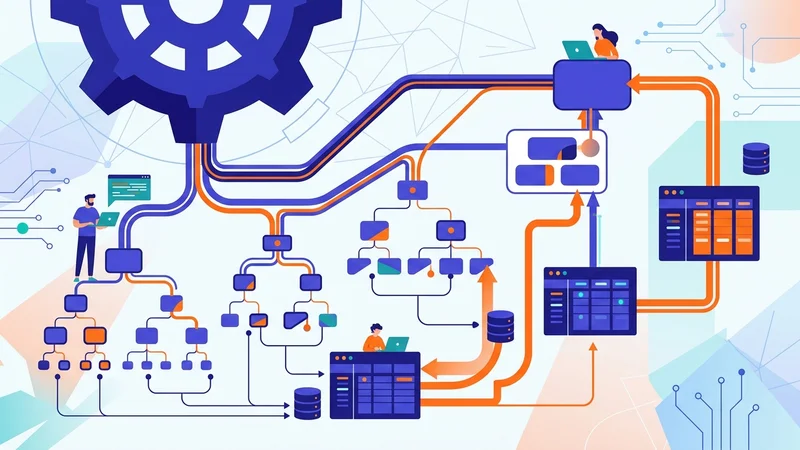
In the context of business and IT, dynamic programming can significantly enhance operational efficiency by solving complex optimization problems. For instance, it is widely used in route optimization for logistics and ride-sharing services, image compression for faster load times on social media platforms, and even in financial portfolio optimization.
Key Features of Dynamic Programming#
- Optimization Over Recursion: Dynamic programming optimizes recursive solutions by storing the results of sub-problems, thus avoiding repeated calculations and improving efficiency.
- Breaking Down Complex Problems: It simplifies complex problems by dividing them into smaller sub-problems, which are easier to solve and can be combined to form the overall solution.
- Memoization and Tabulation: These are two primary techniques used in dynamic programming. Memoization involves storing the results of expensive function calls and reusing them when the same inputs occur again. Tabulation, on the other hand, involves solving sub-problems in a bottom-up manner, starting with the simplest ones.
Applications of Dynamic Programming#
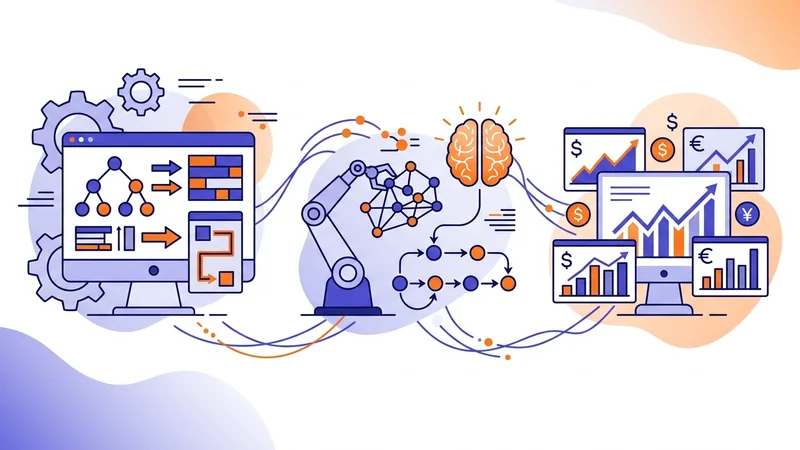
Dynamic programming has a wide range of applications across various industries, including computer science, finance, and artificial intelligence.
Computer Science Applications#
In computer science, dynamic programming is used in several key areas:
- Shortest Path Algorithms: Dynamic programming is crucial in finding the shortest path between two points in a network, which is essential for GPS navigation systems and network routing.
- Text Editing and Spell Checkers: Spell checkers use dynamic programming to analyze words and suggest corrections based on patterns and previously encountered words.
- Sequence Alignment in Bioinformatics: Scientists use dynamic programming to compare DNA or protein sequences, helping in disease analysis and drug development.
Finance and Economics Applications#
In finance and economics, dynamic programming plays a vital role in:
- Portfolio Optimization: Investment firms use dynamic programming to create optimal investment portfolios by considering factors like risk tolerance and expected returns.
- Dynamic Pricing: Airlines and other companies use dynamic programming to optimize pricing strategies based on demand and competitor pricing.
Artificial Intelligence Applications#
In AI, dynamic programming is used in:
- Speech Recognition: Speech recognition software uses dynamic programming to break down complex sentences into smaller parts for analysis.
- Machine Translation: Translation software employs dynamic programming to find the most optimal sequence of words in the target language.
Book a call
Benefits of Dynamic Programming in Business#
The integration of dynamic programming into business operations can yield several benefits:
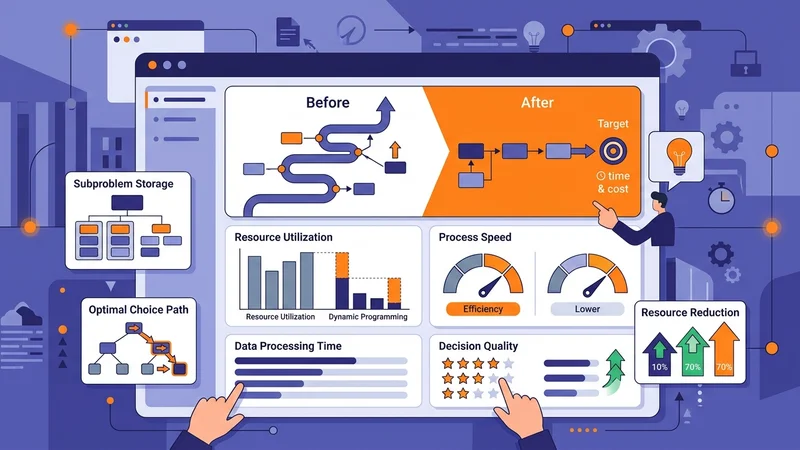
- Enhanced Efficiency: By solving problems more efficiently, businesses can reduce operational costs and improve productivity.
- Accuracy and Precision: Dynamic programming ensures that all possible scenarios are considered, leading to more accurate and precise solutions.
- Competitive Advantage: Companies that adopt dynamic programming can gain a competitive edge by optimizing complex processes and making better decisions.
Implementing Dynamic Programming in IT Projects#
When implementing dynamic programming in IT projects, several factors should be considered:
- Choice of Programming Languages: Languages like Python, with its built-in memoization libraries, can facilitate the implementation of dynamic programming algorithms.
- Data Structures: Efficient use of data structures such as arrays or hash tables is crucial for storing and retrieving sub-problem solutions.
Challenges and Limitations#
While dynamic programming offers significant advantages, it also presents some challenges:
- Memory Consumption: Dynamic programming often requires substantial memory to store the solutions of sub-problems, which can be a limitation for large-scale problems.
- Cognitive Load: Understanding and applying dynamic programming requires a deep understanding of the problem structure and the ability to break it down into manageable parts.
Real-World Examples of Dynamic Programming#
Let's explore a few real-world examples that illustrate the power of dynamic programming:
1. Climbing Stairs Problem#
Imagine you are climbing a ladder with N steps, and you can climb either one or two steps at a time. Dynamic programming can be used to calculate the number of different ways to reach the top. This problem demonstrates how dynamic programming breaks down a complex problem into smaller sub-problems and solves them efficiently.
2. Longest Increasing Subsequence#
Given a sequence of numbers, the goal is to find the longest subsequence where each element is greater than the previous one. Dynamic programming solves this by comparing each element with all previous elements and storing the lengths of the longest increasing subsequences ending at each position.
3. Edit Distance Problem#
The edit distance problem involves finding the minimum number of operations (insertions, deletions, substitutions) needed to transform one string into another. Dynamic programming solves this by creating a matrix where each cell represents the edit distance between substrings of the two strings.
Future of Dynamic Programming#
As technology advances and computational power increases, the applications of dynamic programming are expected to expand further. It will continue to play a crucial role in solving complex optimization problems across various industries, from finance to artificial intelligence. By understanding and leveraging dynamic programming, businesses can unlock new levels of efficiency and innovation in their operations.
Written by

Mario Meyer is the founder of Reyem Tech and a fractional CTO for owner-run companies in Canada and the US. He has 25+ years of executive and hands-on engineering experience across Laravel, Rails, React, AWS, Azure and Kubernetes, and works with owners on technology strategy, due diligence and getting stuck software projects back on track.
Frequently Asked Questions
What is dynamic programming?
Dynamic programming is a problem-solving strategy that involves breaking down complex problems into smaller sub-problems, solving each sub-problem only once, and storing their solutions to avoid redundant computation.
What are the key features of dynamic programming?
The key features include optimization over recursion, breaking down complex problems into smaller sub-problems, and using memoization and tabulation techniques.
What are some common applications of dynamic programming?
Dynamic programming is applied in various fields such as computer science (e.g., shortest path algorithms), finance (e.g., portfolio optimization), and artificial intelligence (e.g., speech recognition).
What are the benefits of using dynamic programming in business?
The benefits include enhanced efficiency, accuracy and precision in solutions, and gaining a competitive advantage by optimizing complex processes.
What are some challenges associated with dynamic programming?
Challenges include high memory consumption for storing sub-problem solutions and the cognitive load required to understand and apply dynamic programming effectively.
How does dynamic programming improve efficiency in IT projects?
Dynamic programming improves efficiency by solving problems more efficiently, reducing operational costs, and improving productivity through optimized algorithms.
What programming languages are suitable for implementing dynamic programming?
Languages like Python, with its built-in memoization libraries, are suitable for implementing dynamic programming algorithms.
What is the future outlook for dynamic programming?
As technology advances, dynamic programming is expected to expand its applications further, playing a crucial role in solving complex optimization problems across various industries.
What are some real-world examples of dynamic programming?
Examples include the climbing stairs problem, longest increasing subsequence, and edit distance problem, which demonstrate how dynamic programming breaks down complex problems into manageable parts.
How does dynamic programming differ from recursion?
Dynamic programming optimizes recursive solutions by storing the results of sub-problems to avoid redundant computations, whereas recursion involves repeated function calls without storing results.